
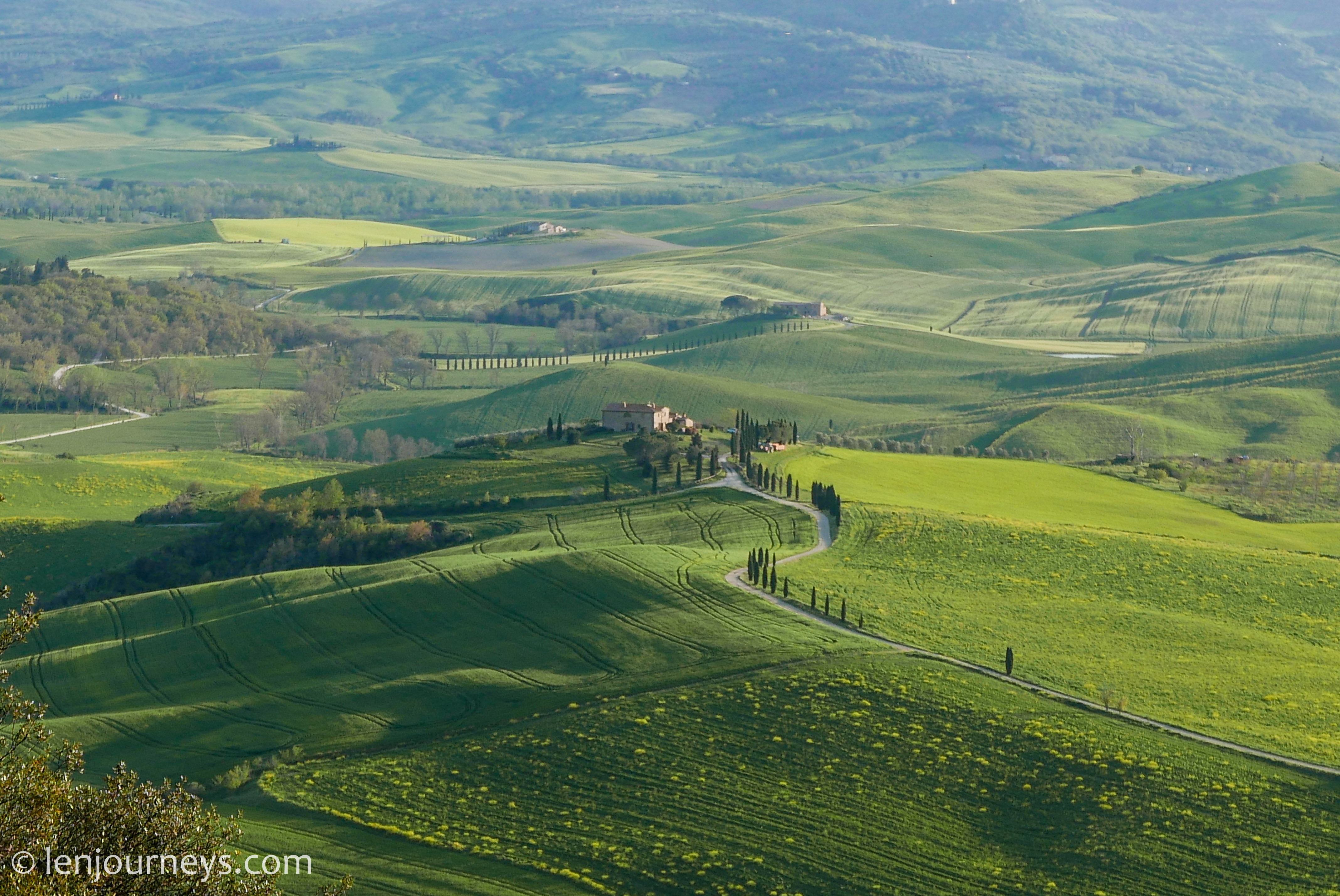
When hearing about the Tuscan countryside, the images of gently rolling hills, artistic cypress-lined avenues, and tranquil farmhouses often come up in people’s minds. Sprinkling in several medieval and Renaissance towns, we have a magnificent landscape that garnered UNESCO World Heritage Site status.
No matter how often I have seen the Tuscan countryside in photos and films, the real things are more magical than I could envision: a pastoral landscape with endless waves of green gently rolling to the horizon. Dot throughout are patchwork fields, vineyards, fragrant olive groves, and charming farmhouses, each stately framed between two neat rows of cypress trees. In the backdrop rise crumbling castles and historic villages, most of which are medieval and Renaissance time-capsules magically transported to the modern day.
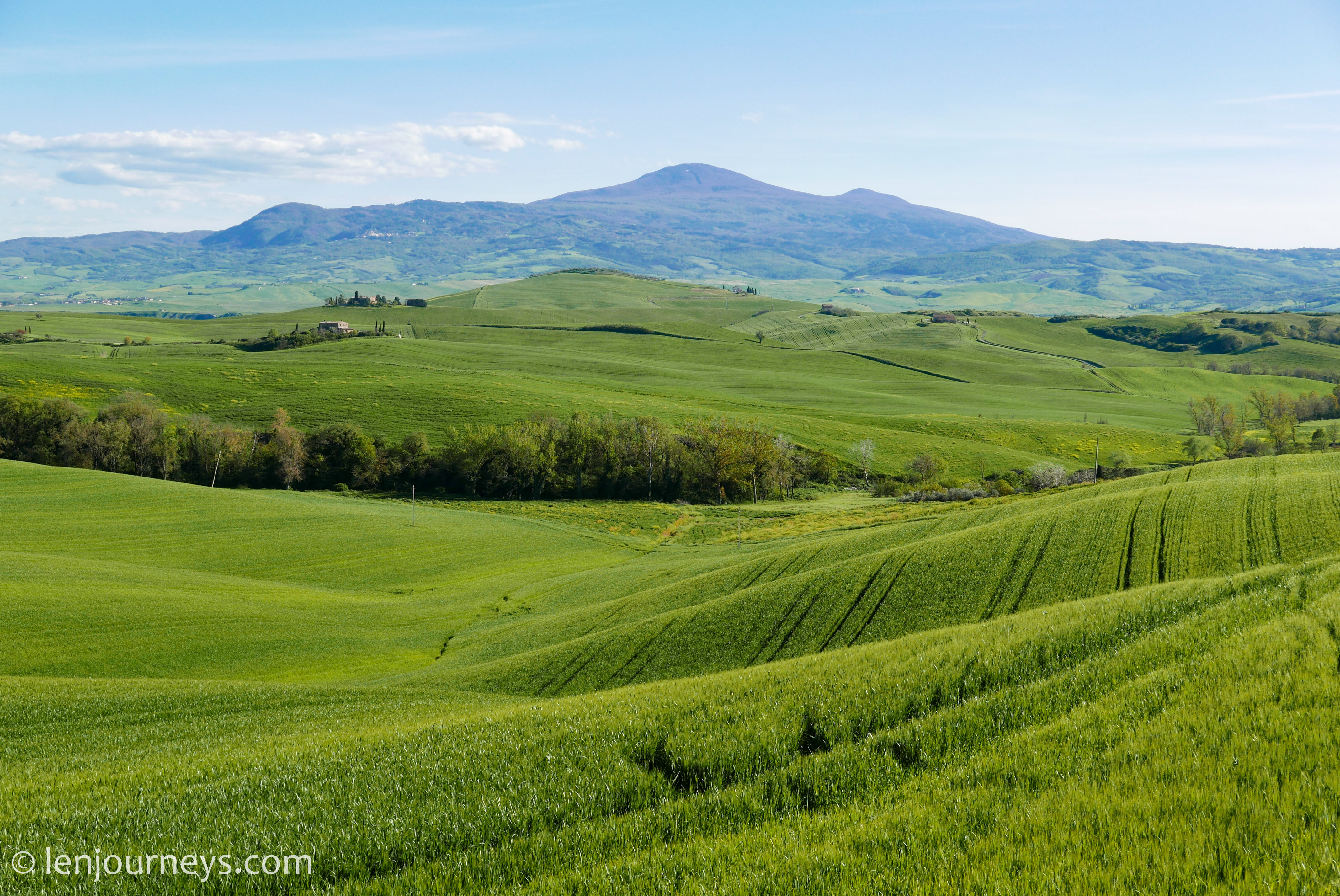
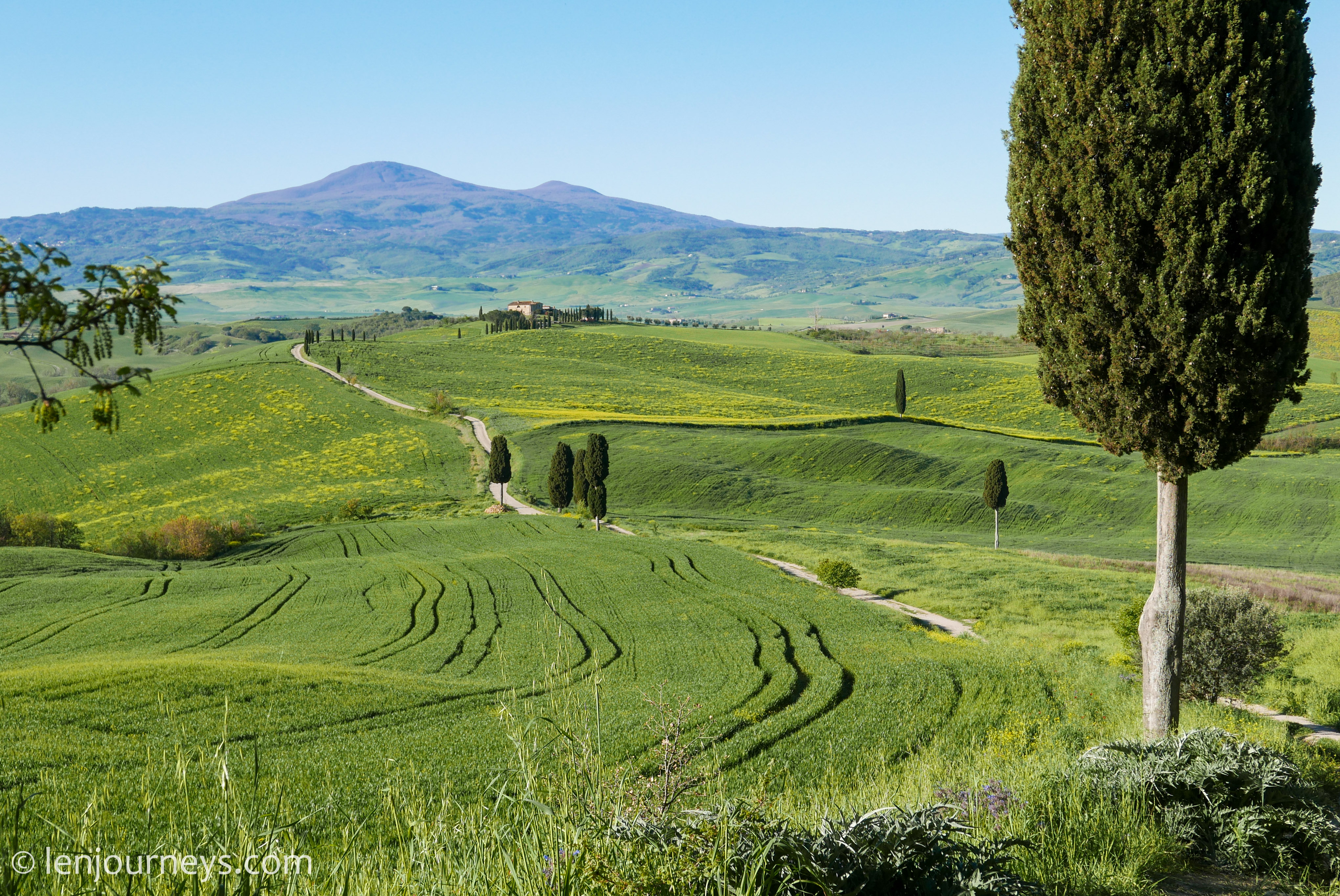
Every corner of this landscape is a photographer’s dream, and I’ve lost track of the countless times I’ve paused to capture its distinctive charm. The splendor culminates in Val d’Orcia – a vast and aesthetically pleasing agricultural hinterland of Siena. This idyllic area, named after the meandering Orcia River along its southern border, has proudly held UNESCO World Heritage status since 2004. It retains much of its graceful Renaissance layout, comprising a network of farms, woodlands, monasteries, and old towns nestled among soothing green hills.


1. Val d’Orcia
Val d’Orcia was not always the picture-perfect we see today. These flat chalk plains, on which rise almost conical hills, were largely abandoned by the early Middle Ages, even though the Etruscans and then the Roman Empire used to cultivate this area. The valley experienced a revival during the feudal period around the 10th and 11th centuries, with monasteries, castles, and fortresses sprang up to compete against each other along the Via Francigena – an important trade route connecting Rome with northern Italy and beyond.
Yet the true transformation of Val d’Orcia occurred when it integrated into the city-state of Siena, which gained prominence in banking and commerce during the 13th and 14th centuries. Wealthy Siennese began investing in agriculture, turning the rural landscape south of the city into a productive farmland. They also financed the development of villas, settlements, and fortifications atop the undulating hills, resulting in picturesque villages such as Castiglione d’Orcia, San Quirico d’Orcia, Montalcino, and Pienza. Eventually, Val d’Orcia became an outstanding example of good governance and agricultural prosperity.
A Renaissance utopia where nature blends with human activities.
This golden era drew to a close at the end of the 16th century when Siena’s arch-rival, the Medici family of Florence, assumed control over Tuscany. Val d’Orcia, alongside a weakening Siena, subsequently lost its economic significance. However, in a remarkable twist of fate, this prolonged decline inadvertently helped preserve the Renaissance character and designs of the landscape. These days, Val d’Orcia is celebrated as a Renaissance utopia where stunning nature seamlessly intertwines with human activities. The sweeping valley is often seen as a slice of paradise that has captured the hearts and souls of artists, photographers, and filmmakers—just as it did with Renaissance painters centuries ago.


2. Pienza
Among the stunning hilltop settlements that adorn the Val d’Orcia landscape, Pienza is perhaps the most unusual. This town is relatively “new” compared to its neighboring medieval villages, established in 1459 through the vision of Cardinal Enea Silvio Piccolomini. Once ascending to the papacy as Pope Pius II, he ennobled his birthplace, the hamlet of Corsignano, into an “ideal town” and named it Pienza. Depicting in the anonymous Renaissance painting The Ideal City, an “ideal town” is a symmetric, well-balanced urban planning built around the needs of its inhabitants. The heart of it is a central square, from which the urban tissue, such as streets, houses, and communal facilities, radiates.
The first ideal Renaissance city.
According to UNESCO, Pienza is the first application of this Renaissance Humanist concept, featuring a neatly paved trapezoidal square defined by gorgeous buildings. These include the Palazzo Piccolomini, famous for its beautiful hanging garden; the Palazzo Borgia, constructed for the young cardinal Rodrigo Borgia, who later became Pope Alexander VI; and the Palazzo Comunale, which houses the town council. Yet the most striking structure is the Duomo, which features a Renaissance exterior and an interior in the late Gothic style characteristic of southern German churches. Each side of the square has seats, allowing people to meet and spend time with one another. Moreover, an ornate water well adds convenience for Pienza’s residents.
The architect Bernardo Rossellino also built a new road to connect the two gates of the defensive walls, passing by the central square. He largely respected the town’s medieval urban layout, reflected in the cobblestoned alleys, sunny courtyards, and honey-hue stone houses. They evoke tales of centuries past, providing the best way to immerse oneself in Pienza’s beauty and rich history.


Tips for Visiting Val d’Orcia
- The nearest large town is Siena, located approximately 50 kilometers north of Val d’Orcia.
- Due to the scarcity of public transportation, the most convenient way to explore Val d’Orcia is by private car or bike. Some local trains run past this area, but the stations are far away.
- Hiking is a great option to enjoy the magnificence of this landscape as one can get closer to the fields. But be mindful and respectful because many are private properties.
Recommended Stay
Just steps from Pienza’s medieval gate, La Bandita Townhouse is a fantastic mix of old and new. Having previously been a nunnery, this boutique hotel blends with the Renaissance town, so much so that it’s only recognizable thanks to a small sign on the timeworn façade. Inside are twelve airy, loft-like rooms and suites that veer toward minimalism, with stark white décor, impeccable parquet floors, sleek bathroom fixtures, and modern lighting systems. Despite this contemporary aesthetic, yesteryear’s charms are evident throughout the hotel, including the exposed stone walls, the wooden beam ceilings, and the delightful interior courtyard. The old also softens the new in the library lounge, where guests can unwind on the crisp-colored suede sofa amidst a collection of books and vinyl records.
A fantastic mix of old and new.
Additionally, the hotel’s restaurant offers simple yet flavorful local dishes, giving guests a taste of Tuscan life. Think of black croutons made with chicken livers and anchovies, succulent pulled pork, and tender Florentine steak, typically served with fresh pasta or tortellini. For dessert, there are Cantuccini—classic Tuscan almond biscuits dipped in a sweet, honey-like wine known as Vin Santo (Saint Wine).


DISCLAIMER:
My recommendation is written based on my personal experience. It was neither sponsored nor solicited by La Bandita Townhouse or any third party. All texts and pictures reflect my own opinions and are provided solely for informational purposes. I will not be liable for any errors or damages caused by using this information.


Your photos definitely captured that image of Tuscany many people, including me, have. How marvelous to be there when the weather was nice! That particular image of low clouds over the hills is so sublime. This is such a perfect post to read in a calm Sunday morning, Len.
Thank you, Bama! The landscape of Val d’Orcia surely can calm the mind. Might be a reason why it’s often picked as desktop wallpaper 😛 I wish I had brought a telephoto lens. Those I captured from the distance were not so clear. Viewable on screens but not printable 🙁
Your photos are just stunning… what a glorious post this has been to make the spirit lift!
I’m glad to hear that the photos of Val d’Orcia can uplift your spirit. Thank you for your kind words, Anna 🙂
The hills of Tuscany are what I needed this morning. This is a beautifully written piece. Your photography is inspiring. Thank you for this moment of peace and possibilities this morning.
Thanks for the kind words, Dalo 🙂 And sorry for the extremely late response. Somehow, I missed your comment.
Beautifully written piece with beautiful photography, Len. From your perspective, Tuscan does seem more magical than it is in photos and films. I like how you describe Val D’Orcia, ‘stunning nature seamlessly intertwines with human activities’. Nature and human can exist side by side and peacefully as you showed. It really is something how everything seems so soft even with modern hotels and amenities – it’s an art all round. Wonderful post 🙂
Many thanks, Mabel 🙂 The landscape of Val d’Orcia is indeed spectacular. It’s artificial, but so beautiful and pleasant that you can’t take your eyes off it.